
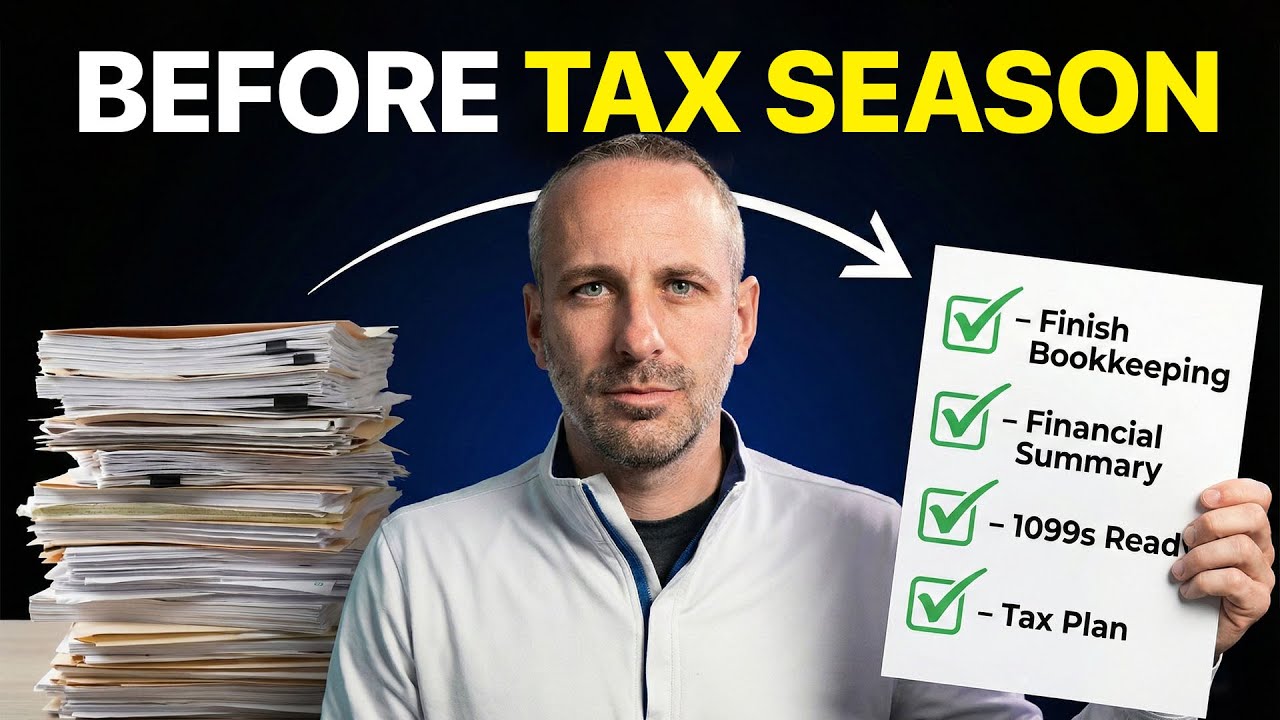
January Tax Checklist for Small Business Owners
January is when most tax problems quietly begin.
Not because business owners do nothing, but because they move forward without closing the year behind them. Unfinished bookkeeping, missing documents, rushed decisions, and no clear tax plan all create problems that show up months later when it is harder and more expensive to fix.
This January tax checklist for small business owners walks through the exact steps you need to take to start the year clean, organized, and in control of your taxes.
Why January Is the Most Important Month for Small Business Taxes
Small business tax planning in January sets the foundation for the entire year.
If you start the year with incomplete records, unclear numbers, or no tax strategy, every decision you make compounds the problem. January is the only time you can fix last year properly while still having full control over the year ahead.
When January is handled correctly, tax season becomes a process instead of a scramble.
Rule 1: Close Your Year-End Bookkeeping the Right Way
Year-end bookkeeping for small businesses is not just about getting numbers into software. It is about accuracy.
Before you move forward, your books for the prior year must be complete and reconciled.
According to IRS recordkeeping guidelines for small businesses, business owners are required to keep accurate books and supporting documentation to substantiate income, deductions, and credits.
This means:
• Every transaction is categorized
• Business and personal expenses clearly separated
• Bank and credit card balances matching real statements
• Loans and liabilities reflected correctly
Once bookkeeping is finalized, generate an income statement and balance sheet. Review them side by side with the prior year. Large swings often signal missing expenses, miscategorized transactions, or personal charges paid outside the business.
Rushed bookkeeping leads to missed deductions or inflated numbers that create audit risk. Clean bookkeeping gives you confidence and better tax outcomes.
Rule 2: How to Review Financial Statements Before Tax Filing
Knowing how to close business books for year-end includes reviewing what the numbers actually say.
Look for:
• Expense categories that dropped unexpectedly
• Income that does not match reality
• Accounts that were never reconciled
• Balances that do not match actual bank or credit card statements
If something looks off, fix it now. Once inaccurate books are handed to an accountant, mistakes carry through the entire tax return.
Good tax planning starts with good data.
Create a Financial Summary Document for Better Tax Planning
Most business owners have accounts scattered everywhere.
Bank accounts. Retirement accounts. Brokerage accounts. Insurance policies. Debts. Investments.
A financial summary document brings everything into one place.
This is a simple spreadsheet that includes:
• Cash and liquid accounts
• Investments and retirement accounts
• Illiquid assets like real estate
• Mortgages, loans, and other liabilities
• Insurance policies and coverage details
Updating this once a year gives you a clear snapshot of your financial life. It helps with tax planning, emergency decisions, estate planning, and advisor guidance.
Many tax strategies only become obvious once everything is visible on one page.
Rule 3: The January 31 1099 Deadline Every Business Owner Must Know
The 1099 deadline for small business owners is January 31.
The IRS 1099 filing requirements outline who must receive a form, what payments count, and how filing obligations work.
If you paid contractors $600 or more during the year, you may be required to issue a 1099. This applies to payments made by cash, check, or direct deposit.
You generally do not issue a 1099 if payment was made by credit card or payment processor, since those are reported separately.
To file correctly, you need:
• A completed W-9 from each contractor
• Accurate payment totals from your bookkeeping
• Correct classification of payment methods
Missing this deadline leads to penalties that add up fast. January is the time to handle this cleanly while the information is still fresh.
Rule 4: Why Waiting Until December Breaks Your Tax Strategy
Tax planning strategies for small business owners do not work when everything is delayed.
Trying to implement strategies in December creates rushed decisions, missed opportunities, and unnecessary stress. Many strategies require setup time, consistent execution, or income planning throughout the year.
January allows you to spread strategies across the calendar instead of forcing everything into the final weeks of the year.
Two strategies per month are manageable. Twenty strategies in December are not.
How to Start 2026 With a Proactive Tax Plan
January is the moment to evaluate what worked and what did not.
Ask yourself:
• Which strategies saved money last year
• Which strategies created complexity without benefit
• Whether income or expenses will change this year
• Whether your business structure still makes sense
If you can’t name one strategy that worked last year, you were not doing real tax planning.
A proactive tax plan aligns with your income, growth goals, hiring plans, and retirement objectives. It is built early and adjusted throughout the year.
The IRS small business tax guide provides an overview of business tax responsibilities and planning considerations that business owners should review annually.
The Bottom Line
A strong year doesn’t start with goals. It starts with cleanup.
The IRS business tax calendar can also help business owners stay ahead of key deadlines throughout the year.
This January tax checklist for small business owners is about closing the loop on last year so it does not follow you into the next one.
Clean books. Clear records. Timely filings. A real tax plan.
If you want help implementing these strategies and lowering your tax bill legally, start with the Tax Savings Starter Kit or book a free demo to see how TaxElm supports proactive tax planning year-round.
Transcript
[00:00:00] Introduction: Start the New Year Right
[00:00:00] Mike J: It is January the start of a new year in the last chance to wrap up the previous one with intention. But before you get caught up in new goals, there are four key financial tasks that can save you stress, time, and even money as tax season starts to creep in. Whether you are a DIY or work with a pro, if you don’t get these done now, you’ll be paying for it.
[00:00:19] Literally paying for it later. So let’s talk about the real January to-do list for every single business owner.
[00:00:43] The first thing I wanna say is welcome to 2026. I hope you had a great 2025 and there’s just some things that we need to do to finish out and close out 2025 before we can truly dive into this new year.
[00:00:55] And the last thing we wanna do is be worried about 2025 for the next. [00:01:00] Month, two month, three month. And so that’s why I wanted to talk about today, how it’s so important to get these things now so you can move on to a new year and not always be thinking about the past and looking in the back.
[00:01:10] Step 1: Finalize Your Bookkeeping
[00:01:10] Mike J: So step number one, I need you to finish your bookkeeping and close out.
[00:01:15] 2025, some of the things you need to be looking for. Do you have everything categorized? Do you have every transaction categorized in your bookkeeping file? Once you have that print out an income statement, a balance sheet. Maybe do a comparative from this year’s income statement, balance sheet to last year’s income and balance sheet and see if there’s anything that looks off.
[00:01:31] I always want to do this because, if you see an expense category, it’s way down. Maybe you missed something. Maybe you paid for something personally that you didn’t even realize and now you might be missing out on it if you don’t look in that. Do a quick analyze. Once you have your bookkeeping finalized, things are good.
[00:01:45] Do an analysis of your bookkeeping to make sure things make sense. Are business and personal items clearly separated? Have you finalized all your reconciliations? Do a review of it to see if there’s anything that looks funky. Make sure on your balance sheet that if you have a bank account and [00:02:00] credit card, make sure those balances on what you’re showing.
[00:02:02] On 1231, make sure they match your actual bank account and your actual credit card. Or if you have loans, make sure that those match, because that’s gonna help that proof to say, yeah, these financials are solid. These financials are accurate. You wanna make sure that your balances match actual, because that gives you some confidence in that.
[00:02:20] I talked to way too many business owners, especially many years ago when I was working in firm on a regular basis with these types of things. So many business owners. That they think bookkeeping’s not that important. So they rush through it. They give a, a bookkeeping file that’s not even really accurate, but they just got it done so they can get it off to their accountant.
[00:02:37] And the problem with that is now that bookkeeping is off to their accountant, it’s not accurate and there’s things that missed out. Sometimes you take way too lesson deductions and they’re missing out on tax savings. Sometimes they inflate things way too much and they do more. In the event of an audit is really gonna cause an issue.
[00:02:53] So just take the time. Get your bookkeeping done, completed so that you have accurate complete set of financials, income [00:03:00] statement, balance sheet over to your account so that you can move on and start 2026. Another thing we wanted to do for last year to make sure is that, make sure you start a folder.
[00:03:07] Now for any tax documents that are coming in related to 2025, make sure you start a folder that you’re dumping all those documents in there. If you have a folder, if you save your receipts digitally. Make sure you have that all located in a folder. So in case you need it, in the case of an IS audit out down the road, you can easily come and grab those documents.
[00:03:24] So let’s make sure that you have all the documentation. If you’re implementing tax strategies, the supporting docs, make sure you just have all that buttoned up and good to go so you can get those items over to your accountant. If you can audit down the road, you have all that information available, likely won’t need it, but if you do, you have it there ready and you’re not trying to accumulate and find different documents two, three years from the down the road from now.
[00:03:42] So you’ll think yourself later. Work on some of those. So those items.
[00:03:47] Step 2: Create a Financial Summary Document
[00:03:50] Mike J: The second thing that I think is so important, and as a practice, I actually really enjoy doing at the beginning of the year, and I call this our financial summary document. Every single person, business owner, or not every single person should have what I call a [00:04:00] financial.
[00:04:00] Summary document and within tax down we have a sample of this, a sample that you can use to download, but it doesn’t, it’s really not that, that, that complicated. What is a financial summary document? It’s basically a spreadsheet with a snapshot of assets that you own or assets that you have, retirement accounts.
[00:04:16] What type of insurance policies do you have? Do you have any debts or liabilities on the books? It’s a snapshot that I like to do once a year. Maybe do it once a quarter, make, maybe do it twice a year, whatever it is, but at a bare minimum. Do it once a year where you’re updating this and saying, okay, as of 1231 of last year, here’s where we look.
[00:04:33] Here’s the assets that we have. Here’s the retirement accounts that we have, and here’s any kind of debt we have and insurance policies. And typically what I really like to do when I’m putting this document together, is on the asset side, and this could be a simple spread. You are gonna list like the asset name, the account, how much is in it, and any kinda notes related to that.
[00:04:52] And I like to break assets down into two separate pieces. The first one is what I call liquid assets. And so that’s gonna be things like crypto, [00:05:00] that’s gonna be bank accounts, money. You have bank accounts, maybe a brokerage account that’s gonna be your liquid assets. And we want a number for that. And then we’re gonna have what I call illiquid assets. These are things that are wrapped up into different policies, or maybe it’s a, you’re invested in a real estate item, but you can’t access those funds back. They expect to maybe turn around or target to turn that real estate investment back in five years, 10 years, but you can’t access necessarily those funds right away.
[00:05:25] That would be an illiquid asset, and sometimes in the illiquid side we break it down to pre-tax versus after tax, so traditional retirement accounts versus Roth. What this does is having this financial document in place. Gives you some confidence, gives you some ideas of, okay, where are you at?
[00:05:40] Because so many people get so busy running a day today. There’s retirement accounts over here, there’s brokerage accounts over here, there’s real estate investments. All these different things. It’s one document that kind of illustrates what does your financial life look like and we update it on a regular basis.
[00:05:54] And it’s a really good practice to do at the beginning of the year. ’cause you see what’s changed from year to year, but then [00:06:00] also what does next year look like? What are your goals? What do you want this, what do you want in this document to change as you look at this new year that we’re entering now? So first on the Excel document, and again, we have a sample in tax zone, but it doesn’t have to be that complicated either.
[00:06:13] The first tab, I have assets, cash, investments, assets that you have. The second tab on this document, I normally put debt. So if you have mortgage, if you have car loans, any kind of debt you have related to these items, and this is more personal side, so business, you’re gonna have financial statements and bookkeeping files.
[00:06:29] This is on the personal side, any kinda mortgages credit cards, car payments, all those different things. We want a record of that. If you have insurance policies, so think of life insurance policies, maybe car insurance, home insurance, all those different things, whether it’s for you, your spouse, your children.
[00:06:42] Have a doc have a page that outlines that, and this is gonna be your document that’s live and breathing. Print it out, put it in your will, put it in your estate planning folder. That kind of in indicates, okay, here’s where we’re at this year. I love to do this, so why does it matter?
[00:06:57] It’s a huge help in financial planning. It really helps you [00:07:00] understand kinda where you’re at. Your financial advisor’s gonna love you. Your accountant’s gonna love you because you’re providing this information that gives you kinda the financial picture, the financial history of you. It also helps an emergency decisions.
[00:07:11] If an emergency comes up and there’s a lot of cash that’s needed, it helps you understand where you’re at, where. How do we need to move things around? What do things look like? It also helps you with tax strategy. You might realize that you have a ton of money in traditional accounts that maybe you wanna do a Roth conversion, and you might not realize that until you actually get it on paper.
[00:07:29] It helps advisors give you smarter advice, faster advice, and really is a financial tool that I think everybody should do. Every year we want to update it. Either set one up if you don’t have one set up already. If you listen to our episode last year and the year before that where we talk about these on a regular basis, make sure you update.
[00:07:45] Take this time to update whatever you did last year to make sure it’s accurate because you know what balances change. Investments grow investments. Decrease. We want to keep updating that. But if every single person, business owner or not, should have a financial summary document. Again, tab one, [00:08:00] cash and investments, tab two, debt or liabilities that you have.
[00:08:03] And tab three is gonna be any kind of insurance policies that you have updated on a regular basis, at least annually at a bare minimum. Now, quick break. If you are looking to make 2026 your most strategic and least so stressful year yet, grab our free tax savings starter kit@taxsavingspodcast.com. Slash starter kit.
[00:08:20] That’s tax Savings podcast.com/starter kit. It’s packed with tax tips, deductions checklist for a free discovery call and so much more. So check that out. Alright, back to our list of what needs to be done here at the beginning of January to close out 2025 and being able to help us shift our focus and attention into 2026.
[00:08:39] Step 3: File Your 1099s
[00:08:39] Mike J: The number three item is 10 90 nines. January 31st is the deadline. You don’t wanna miss it. Take the time now, especially as you now you got that bookkeeper file that we just talked about. You got that all at record. If you’re paying contractors over $600, make sure you’re filing a 10 99 for them. File it by January 31st.
[00:08:55] We did an episode last week talking about this, so definitely check out that in order to file a 10 [00:09:00] 99 for somebody. You need a completed W nine for them that’s gonna give you all their information, their name, their address, their social security number, or EIN for the business. You’re gonna need to know how much have you paid them throughout the year.
[00:09:10] That’s why bookkeeping is so important, not only for many other purposes, but just this purpose of loan is how much did you pay them because that’s the amount that’s gonna go on the 10 and nine. And and then you need to make sure if you paid them for via credit card, debit card, PayPal, something like that, you don’t need to process a 10 99 for them.
[00:09:26] But if you paid them via cash check, direct deposit. Then you would need to process a 10 99 for them. So just make sure you get done. Avoid any kinda unnecessary penalties or interest or anything like that. Just get the 10 90 nines done due by January 31st. Now find the item as we enter into 2026. I think what we’ve talked about today is bookkeeping file up to date, get it done for 2025, and then get on a plan so that you’re doing it on a regular basis as we enter 2026.
[00:09:52] Now, the financial summary document, I’m telling you this is one of my favorite activities to do at the beginning of the year. Everyone should be doing it and keep it up to date because it’s so [00:10:00] cool to see where things have gone throughout the past year. Where are you at and what is your goals?
[00:10:04] What do you want this sheet to look like when you’re doing this? And exactly a year from now, what do you want this sheet to look like? And then 10 90 nines, get those done.
[00:10:11] Step 4: Plan Your Tax Strategy
[00:10:11] Mike J: Finally, attacks. Planning plan. I always say use January as momentum to look ahead. Look at your tax plan. What worked from your tax planning last year?
[00:10:22] What didn’t work? Is there any major changes expected in income or expenses or life events or different things? This year, now is the time to analyze where you’re at and if you’re looking back and saying. What worked with tax planning, you can’t really give an answer. That means that you didn’t do enough tax planning.
[00:10:37] That means that you didn’t do enough. Everybody should be doing tax planning every single year, regardless of your income. There should be some sort of tax planning being done, and if you can’t tell me one thing that worked last year, that means that you need to get outta that. You need to make a plan this year.
[00:10:52] For what that’s gonna look like. You know what didn’t work last year? If you let, if you did a strategy last year but it just didn’t work, it didn’t produce the [00:11:00] savings you expected or was a lot of work, what didn’t work and what can we do and what can we look at differently this year? I always say make a plan for tax strategy.
[00:11:08] At Taxon we talk all the time. We’re in January, now is a great time. Let’s say you, submit your tax blueprint. In tax element, it lists out exactly what strategies you need to be focusing on in January, let’s say there’s 26 strategies that you need to be working on. If we start that in January, we can say, okay, January, we’re gonna focus on two strategies.
[00:11:28] February, we’re gonna focus on two strategies. March, we’re gonna focus on two strategies, and we can build that out, implementing two strategies a month. Not that bad. Pretty easy. Doesn’t take a lot of time. Can produce a ton of savings, especially if you’re doing it early on in the year, implementing 24 strategies in the month of December.
[00:11:45] Nearly impossible and you might even not even implement one of them. So that is why you have so much power to take it by the, take it by the bull right now and start to implement and think about that tax strategy, build older plan for what strategy you’re gonna implement when [00:12:00] you’re gonna implement it.
[00:12:01] Look at what worked last year, what didn’t, and how we need to change that. Align your strategy with your goals. Where do you want retirement contributions to be at? Start to plan for that. Now, are you planning to hire employees? What does that look like? Do we need to set things up for that? What does that look like?
[00:12:14] Is your legal and tax structure set up correctly? Are you organized in the most tax efficient way? Now is a great time to start planning that. If you don’t know anything about tax strategy, you just listen to this for the first time and thinking about, okay. Finally, 2026 is that year where I’m gonna pay the least amount of taxes legally possible.
[00:12:30] I’m gonna make an action. To do it. What are the steps you need to take first? You’re in the right place, listening to our podcast, our YouTube channel. Go to tax savings podcast.com.com. Go to tax savings tv.com. The next step I would say is I have a book on Amazon, the Small Business Tax Savings Handbook.
[00:12:47] Go on Amazon, download this. This is great desktop guy that’s gonna guide you. Throughout the year, we have a software called Tax Out where we tell you exactly what strategies to implement. We have implementation modules to help you implement them, and you have unlimited access [00:13:00] to a team of tax professionals to help you along the way.
[00:13:03] We have plenty of resources for you. Find out which one works for you in your stage of business, in your stage of life, and make it an action that in 2026, you’re gonna take this tax planning thing seriously. I’m super excited to be on that journey with you.
[00:13:16] Conclusion: Start Strong in January
[00:13:16] Mike J: Now, here’s the bottom line. Starting strong in January isn’t just about setting new resolutions.
[00:13:21] It’s about wrapping up the last chapter so that this next one is easier to write if you want 2026 to be your most profitable and tax smart year. Yet it starts now with clean books, a clear summary, timely, 10 90 nines, and a game plan. For tax savings. If this was helpful, hit that subscribe button, leave a review, and share it with someone who’s behind on their January checklist.
[00:13:42] And if you want help from our team of tax professionals implementing everything we talked about today and many other tax strategies, visit tax elm.com. That’s TAX elm.com, or click the link into the description for a free discovery call. We are helping small business owners like you legally lower your tax bill every single day.[00:14:00]
[00:14:00] Thank you, and I’ll see you on the next one.
[00:14:02] Mike J: Thanks for tuning in to the Small Business Tax Savings Podcast. We hope today’s episode sparked some brilliant ideas to help you save on taxes and grow your wealth. If you loved what you heard, hit the subscribe button and share the wealth with fellow entrepreneurs. For a treasure trove of tax saving resources, visit tax Savings podcast.com.
[00:14:26] There you’ll find tools, guides, and all the info you need on reducing your taxes. Let’s elevate your business to new heights together. Remember the insight shared here for educational purposes and not specific tax or legal advice. Always consult with a qualified professional for your unique situation.
[00:14:44] Until next time, keep thriving and saving.