
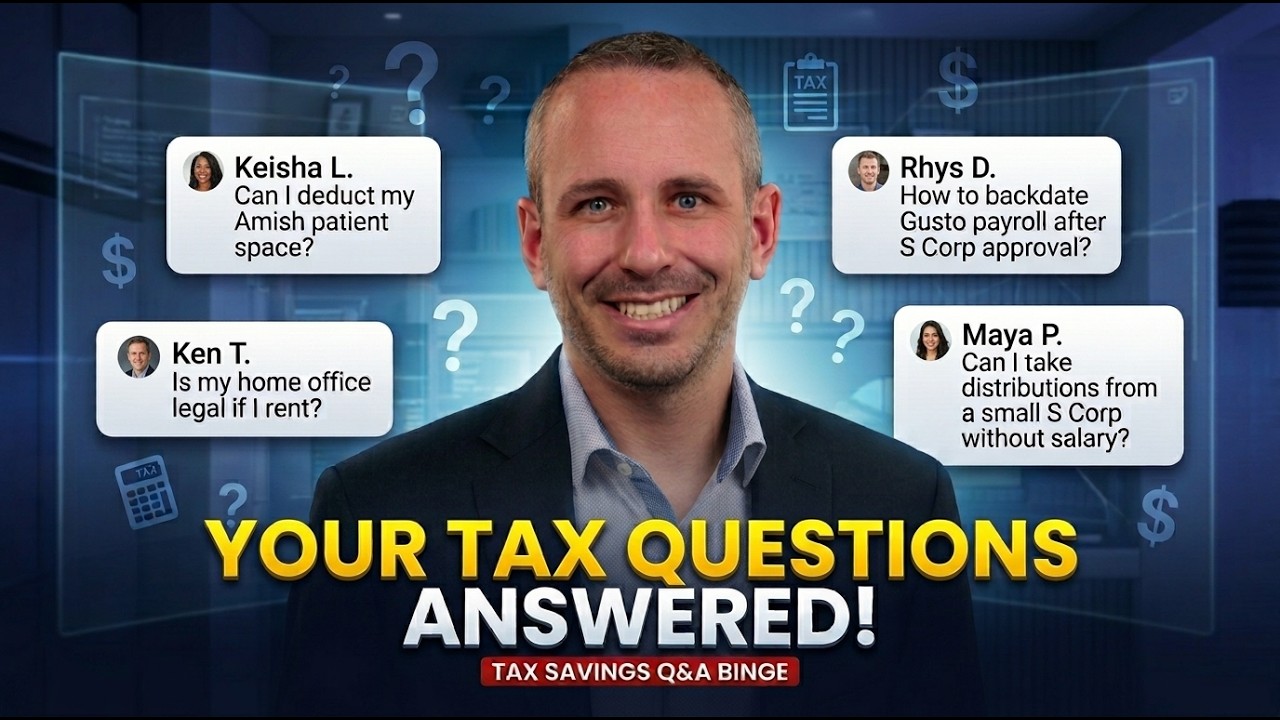
Can you deduct your home office if you rent? When should you switch to an S Corp? And what happens if you’ve made a mistake with your retirement contributions?
These are some of the most common small business tax questions we hear from business owners. While many tax-saving strategies are available, knowing whether you qualify and how to implement them correctly can make a significant difference.
In this guide, we’re answering 15 real questions from small business owners about tax deductions, S Corp rules, retirement planning, and everyday business expenses.
TL;DR: Key Small Business Tax Takeaways
- Home office deductions: You may qualify even if you rent your home, provided the space meets IRS requirements.
- S Corp elections: Businesses consistently earning around $50,000 to $60,000 in annual profit may want to evaluate an S Corp election. This is a planning guideline, not an IRS requirement.
- S Corp reasonable salary: Shareholder-employees generally must receive reasonable compensation for services before taking non-wage distributions.
- Hiring your kids: Certain business structures qualify for payroll tax exceptions when employing children under 18.
- Retirement accounts: Excess IRA contributions should be corrected within applicable deadlines to avoid potential penalties.
- Business deductions: Vehicle expenses, accountable plan reimbursements, and business travel can offer tax savings when handled properly.
The main takeaway: A tax strategy is only as effective as its implementation. Proper documentation, timing, and compliance are essential.
1. Can You Deduct Multiple Home Office Spaces?
Yes, you may be able to deduct more than one workspace in your home if each area meets the IRS requirements.
For example, imagine you’re a physician with a medical office in another town. You also have a home office for administrative work and a separate area where you occasionally see patients.
Your administrative office may qualify if it’s used regularly and exclusively for business and meets the applicable home office requirements.
The separate patient space needs its own evaluation. If you only see patients there a few times a year, it may not meet the regular-use requirement, even if you never use it personally.
The IRS generally requires qualifying home office space to be used regularly and exclusively for business, with certain exceptions and additional conditions.
See IRS Publication 587: Business Use of Your Home.
2. Can You Claim a Home Office Deduction If You Rent?
Absolutely. You don’t need to own your home to qualify for the home office deduction.
If you rent your home and have a dedicated workspace that meets IRS requirements, you may be able to deduct a portion of your rent and other qualifying expenses.
There are two common calculation methods.
Simplified Method
The IRS allows eligible taxpayers to calculate the deduction using $5 per square foot of qualifying business space, up to 300 square feet.
For example, if you have a 200-square-foot qualifying office:
200 square feet × $5 = $1,000 potential deduction
This amount remains subject to applicable income and eligibility limitations.
Actual Expense Method
This method calculates the business portion of qualifying household expenses, including rent, utilities, and insurance.
For example, if your office occupies 10% of your home, you may be able to deduct 10% of eligible shared household expenses.
The best method depends on your expenses and how your business is structured.
For more information, review the IRS simplified home office deduction guidelines.
3. Can You Use the Augusta Rule for Business Meetings at Home?
The Augusta Rule, also known as the 14-day home rental rule, can provide a tax planning opportunity when you rent your residence for legitimate business purposes.
Under the federal rule, if you use a dwelling as your residence and rent it for fewer than 15 days during the year, you generally don’t have to report the rental income.
A business may also qualify to deduct reasonable rental payments for legitimate meetings, depending on its structure and circumstances.
What Documentation Do You Need?
If your business rents your home for meetings, you should have:
- A rental agreement between the appropriate parties.
- A reasonable rental rate supported by comparable properties.
- A meeting agenda and minutes.
- Records showing who attended and what was discussed.
- Documentation of the rental payments.
For example, if you’re hosting a board meeting at your house, compare your proposed rental rate with what a local coworking space would charge for a similar meeting room.
The meeting must serve a legitimate business purpose, and the rental payment must qualify as an ordinary and necessary business expense.
The 14-day rule does not automatically make every payment between you and your business deductible.
See the IRS guidance on short-term residential rentals.
4. Should You Form an LLC Before Getting a Business Loan?
If you’re starting a business and need outside funding, establishing a formal business entity may be worth considering.
An LLC can help separate your business operations from your personal finances and may be useful when applying for financing.
However, forming an LLC is not a universal requirement for obtaining a business loan.
Your funding options may include bank loans, SBA loans, personal financing, or bringing on a business partner.
Before taking on debt, ask yourself how much funding you actually need.
For example, a landscaping business may need equipment before it can operate. A consulting business might be able to start with limited upfront expenses and grow using its initial revenue.
If you can launch with minimal funding, you may be able to establish a customer base before pursuing a larger loan.
5. When Should You Elect S Corp Status?
An S Corp election can be an effective small business tax planning strategy, particularly when your business earns consistent profits.
The main potential advantage is reducing employment taxes on eligible business profits distributed to shareholders rather than paid as wages.
However, an S Corp must pay shareholder-employees reasonable compensation for their services.
How Much Profit Should You Make?
One general planning guideline is to consider S Corp status when your business earns approximately $50,000 to $60,000 or more in consistent annual profit.
This is not an IRS threshold or a guarantee of tax savings.
Let’s say your business earns $60,000 this year, but you expect profits to drop to $20,000 next year.
An S Corp election may create more administrative work than it’s worth if your profits aren’t sustainable.
On the other hand, if you’re consistently earning above that range and expect continued growth, it may be worth running the numbers.
You’ll need to consider your reasonable salary, payroll expenses, separate business tax return, and state-specific requirements.
Eligible LLCs can elect S Corporation tax treatment, but an LLC isn’t required. Eligible corporations can also make the election using IRS Form 2553.
6. Do You Need a Separate Business Bank Account?
Even if you’re a sole proprietor, opening a separate business bank account is one of the simplest ways to improve your financial organization.
A separate account helps you distinguish business transactions from personal spending, making bookkeeping and tax preparation easier.
It can also help during an IRS examination.
Imagine providing bank statements containing hundreds of transactions, with business purchases, groceries, and personal expenses all mixed together.
You would need to identify and support the business-related expenses individually.
A dedicated business account makes that process easier, although you still need receipts and other documentation to substantiate deductions.
While a sole proprietor isn’t generally required by federal tax law to maintain a separate bank account, it’s a practical step worth taking early.
7. How Do You Fix Payroll After a Delayed S Corp Election?
What happens when you elect S Corp status but don’t receive your IRS confirmation for several months?
One common concern is how to address payroll that should have been processed earlier in the year.
Let’s use an example from the podcast.
Example: Correcting $50,000 in Missed Compensation
Suppose your S Corp election is effective January 1, but you’ve already reached October without running payroll.
During the first nine months, you’ve taken money out of the business as distributions. Your accountant determines that $50,000 in gross compensation should have been paid for that period.
The episode discusses using an off-cycle payroll to address the missed compensation.
The correction could involve:
- Determining the appropriate gross compensation.
- Processing payroll and calculating applicable employment taxes and withholding.
- Reviewing amounts already paid to the shareholder.
- Making necessary accounting and payroll reporting adjustments.
The $50,000 is gross compensation, not the amount of tax owed. The actual tax and net pay calculations depend on the circumstances.
Importantly, recording a late payroll does not automatically correct missed filing deadlines or payroll deposit obligations.
You should work with your payroll provider and tax professional to determine the appropriate correction, including whether prior-period returns or deposits need attention.
8. Can You Take S Corp Distributions Without Paying Yourself a Salary?
If you’re an S Corp shareholder who performs services for the company, you generally must receive reasonable compensation before taking non-wage distributions.
This applies even when your business is relatively small.
Your salary should reflect the work you perform, including your responsibilities, experience, time commitment, and compensation for comparable positions.
What If You Leave the Profits in the Business?
If you’re not receiving payments from the company, the compensation analysis may be different.
However, leaving profits in the business does not create a blanket exemption from reasonable compensation requirements. You need to evaluate the services performed and payments received.
The IRS can reclassify distributions and other payments as wages when reasonable compensation hasn’t been paid.
For more information, review the IRS S Corporation reasonable compensation guidance.
9. Can You Hire Your Kids Through an S Corp?
Hiring your children can create legitimate business deductions, but payroll taxes depend on your business structure.
If your business is an S Corporation, wages paid to your children are generally subject to Social Security and Medicare taxes.
Let’s say your S Corp pays your child $10,000 for legitimate work.
Using a simplified combined employee and employer Social Security and Medicare rate of 15.3%, the total payroll tax would be approximately:
$10,000 × 15.3% = $1,530
This simplified example excludes other possible taxes and special circumstances.
Is There a Better Structure?
If your child works for your sole proprietorship, certain payroll tax exceptions may apply.
For example, qualifying wages paid to a child under age 18 by a parent’s sole proprietorship are generally exempt from Social Security and Medicare taxes.
Some S Corp owners explore establishing a separate legitimate business activity through a sole proprietorship or eligible disregarded LLC.
However, creating another entity does not automatically qualify the wages for special tax treatment. The business activity, ownership, employment arrangement, and compensation must meet the applicable requirements.
See the IRS family employment tax rules.
10. How Do You Correct an Excess Roth IRA Contribution?
If you’ve contributed too much to your Roth IRA, it’s important to determine whether an excess contribution actually occurred.
For example, contributing to both a 401(k) and Roth IRA in the same year is allowed, subject to each account’s rules.
However, Roth IRA contribution eligibility can be affected by your income, filing status, and annual contribution limits.
If you’ve exceeded your allowable contribution, you may be able to correct it by withdrawing the excess amount and associated earnings within the applicable deadline.
Uncorrected excess IRA contributions can result in a 6% annual excise tax, subject to IRS limitations.
If you suspect an overcontribution, review your eligibility and contact your retirement account provider before making a withdrawal.
The IRS IRA contribution rules explain the limits and correction requirements.
11. Solo 401(k) vs. SEP IRA: Which Should You Choose?
If you’re self-employed with no employees, a Solo 401(k) and SEP IRA are two retirement savings options worth comparing.
The first question to ask is how much you want to contribute.
If you’re only planning to save a relatively small amount, a traditional or Roth IRA may be sufficient, depending on your eligibility.
However, if you’re looking to contribute more, a Solo 401(k) or SEP IRA may be worth exploring.
Solo 401(k)
A Solo 401(k) generally allows an eligible self-employed person to make contributions in both employee and employer capacities, subject to applicable limits.
This can allow higher contributions than a SEP IRA in certain circumstances.
SEP IRA
A SEP IRA uses employer contributions and can be relatively simple to administer.
The appropriate plan depends on your income, entity structure, employees, and retirement savings goals.
If your primary objective is maximizing retirement contributions, comparing both options can help you determine which plan offers the greatest flexibility.
12. How Can You Avoid Quarterly Estimated Tax Penalties?
If you’re self-employed, you may need to make estimated tax payments throughout the year.
One way to help avoid underpayment penalties is to follow the IRS safe harbor rules.
Generally, applicable safe harbor amounts are based on:
- 90% of the current year’s tax liability, or
- 100% of the previous year’s tax liability, increasing to 110% for certain higher-income taxpayers.
These rules have additional requirements and exceptions.
What If Your Income Changes?
If your business income is relatively consistent, using the prior-year safe harbor may simplify your estimated payments.
However, if your profits increase significantly, you could satisfy the safe harbor requirement and still owe a substantial tax balance when filing your return.
For example, meeting a safe harbor amount doesn’t prevent you from owing another $40,000 if your actual tax liability is much higher.
That’s why it’s important to monitor your current income, not just rely on last year’s return.
Review the IRS estimated tax payment guidelines.
13. Should You Deduct Mileage or Actual Vehicle Expenses?
If you use your personal vehicle for business, there are generally two ways to calculate qualifying vehicle deductions.
Standard Mileage Method: You deduct qualifying business miles using the applicable IRS mileage rate.
Actual Expense Method: You calculate the business-use portion of eligible expenses, including fuel, maintenance, insurance, and depreciation.
Which Method Saves More?
Consider two examples.
Example A: Lower-Cost Vehicle With High Mileage
If you drive an inexpensive vehicle and use it frequently for business, the standard mileage method may provide a larger deduction.
Example B: Higher-Cost Vehicle With Low Mileage
If you own a more expensive vehicle but drive relatively few business miles, actual expenses may produce a better result.
The important consideration is how the method affects your deductions over several years.
For an owned vehicle, choosing the standard mileage method in the first year of business use generally preserves the option to switch to actual expenses later, subject to depreciation restrictions.
If you initially use certain actual-expense depreciation methods, you may lose the option to use standard mileage for that vehicle.
See IRS Publication 463: Travel, Gift, and Car Expenses.
14. How Can Your S Corp Reimburse Your Home Office, Phone, and Internet?
If you operate an S Corp and pay business-related expenses personally, an accountable plan can help you receive qualifying reimbursements without treating them as taxable wages.
An accountable plan is an employer reimbursement arrangement that follows specific IRS requirements.
For example, you might personally pay for:
- Your cell phone.
- Home internet service.
- Qualifying home office expenses.
- Business use of a personal vehicle.
Under a properly administered accountable plan, your S Corp may reimburse eligible business expenses.
What Does an Accountable Plan Require?
The IRS generally requires three things:
- The expense must have a legitimate business connection.
- You must adequately document the expense within a reasonable period.
- You must return any excess reimbursement within a reasonable period.
If your arrangement doesn’t meet these requirements, the payments may need to be treated as taxable compensation.
See the accountable plan requirements in IRS Publication 505.
15. Can You Deduct Family Expenses on a Business Trip?
If you’re traveling for business and your family comes along, you generally cannot deduct their personal travel expenses.
For example, suppose you’re attending a business conference and bring your spouse and children.
Your qualifying business-related travel expenses may be deductible, but your family’s personal expenses usually aren’t.
What If You Need a Larger Hotel Room?
Suppose you book a large suite because you’re traveling with your family.
If the suite costs three times as much as a normal room that would meet your business travel needs, the additional expense attributable to your family generally isn’t deductible.
There may be exceptions when a family member performs a legitimate business role and their travel meets the applicable requirements.
However, simply bringing family members to a meeting or assigning them a title doesn’t automatically make their expenses deductible.
Why Proper Tax Strategy Implementation Matters
One of the biggest lessons from these small business tax questions is the importance of proper implementation.
A legitimate deduction can still be challenged if you don’t follow the applicable requirements.
For example, an Augusta Rule arrangement without reasonable rental rates and meeting documentation may be difficult to support during an audit.
An S Corp that makes distributions without paying reasonable compensation could face employment tax adjustments.
And a business that reimburses personal expenses without following accountable plan requirements may create taxable wages instead of tax-free reimbursements.
Hidden Costs to Consider
Before implementing a new strategy, account for the responsibilities that come with it.
Payroll and Accounting Costs
S Corp owners may need payroll processing, employment tax filings, and a separate business tax return.
State Taxes and Fees
Depending on your state, entity-level taxes and registration requirements can reduce the expected savings.
Recordkeeping
Vehicle logs, receipts, rental agreements, and reimbursement documentation can all be important when supporting deductions.
Penalties and Interest
Late payroll deposits, incorrect filings, and unsupported deductions may result in additional taxes, penalties, and interest.
These costs should be considered alongside the potential tax benefits.
Small Business Tax Planning Checklist
Before implementing any new tax strategy, ask yourself:
- Does my business qualify under the IRS requirements?
- How much could this strategy realistically save?
- What additional expenses or responsibilities will it create?
- Does my business structure affect eligibility?
- Do I need to establish an agreement, policy, or election?
- What documentation must I maintain?
- Are there deadlines I need to meet?
- Have I considered how the strategy affects future tax years?
A little planning upfront can make tax preparation easier and help you avoid mistakes that create unnecessary costs.
Conclusion: Get Your Small Business Tax Questions Answered
Whether you’re considering an S Corp election, claiming a home office deduction, or deciding how to save for retirement, the best approach depends on your business.
These small business tax questions show why it’s important to understand the requirements before implementing a strategy.
A deduction that works for one business owner may not be appropriate for another because of differences in profit, business structure, expenses, and state tax rules.
Before implementing a new strategy, run the numbers, document your expenses, and make sure the potential savings justify the additional work.
With proactive planning, you can identify legal tax-saving opportunities and make more informed decisions for your business.
Find Out Where Your Business Could Be Saving on Taxes
Wondering if you’re missing deductions or paying more in taxes than necessary?
Our free Tax Savings Scorecard helps you identify potential tax-saving opportunities based on your business.
Answer a few quick questions to see which areas of your tax strategy may be worth reviewing.
Take the Free Tax Savings Scorecard
If you’d like help reviewing and implementing tax strategies, visit TaxElm to learn more about our tax planning tools and professional support.
Frequently Asked Questions About Small Business Taxes
1. What are the most common small business tax questions?
Common small business tax questions include which expenses are deductible, whether to elect S Corp status, how to pay yourself, and how to avoid estimated tax penalties. Business owners also frequently ask about home office deductions, retirement plans, and hiring family members.
2. Can I deduct my home office if I rent?
Yes. Renters may qualify for the home office deduction if their workspace meets IRS requirements. Depending on the calculation method, qualifying expenses may include a portion of rent, utilities, and insurance.
3. How much profit should I make before switching to an S Corp?
A common planning guideline is to evaluate S Corp taxation when your business consistently earns approximately $50,000 to $60,000 in annual profit. This isn’t an official IRS threshold. The right decision depends on your reasonable salary, state taxes, and additional administrative expenses.
4. Can I take S Corp distributions without paying myself a salary?
If you perform services for your S Corp, you generally need reasonable compensation before receiving non-wage distributions. The IRS may reclassify distributions as wages when an owner hasn’t been adequately compensated.
5. Can I hire my children through my S Corp?
Yes, but wages paid by an S Corp to your children are generally subject to Social Security and Medicare taxes. Certain payroll tax exceptions apply to qualifying children employed by a parent’s sole proprietorship or eligible parent-owned partnership.
6. What happens if I contribute too much to my Roth IRA?
Excess IRA contributions can trigger a 6% annual excise tax if they’re not corrected within the applicable deadline, subject to IRS limitations. You may be able to correct the excess contribution by withdrawing it and associated earnings. Contact your account provider to determine the appropriate process.
7. Is a Solo 401(k) better than a SEP IRA?
A Solo 401(k) can offer greater contribution flexibility because eligible owners may contribute in both employee and employer capacities. A SEP IRA may be simpler to administer. The better option depends on your income, employees, and retirement contribution goals.
8. How do I avoid quarterly estimated tax penalties?
You can reduce the risk of underpayment penalties by making timely estimated payments that satisfy applicable IRS requirements. Safe harbor calculations often use your current-year or prior-year tax liability. If your income fluctuates significantly, review your estimates throughout the year.
9. Should I use mileage or actual expenses for my business vehicle?
The better method depends on your qualifying business miles, vehicle expenses, and depreciation. Standard mileage may benefit certain high-mileage vehicles, while actual expenses may offer larger deductions in other situations. Your initial deduction method can affect future choices.
10. How can I maximize small business tax deductions legally?
Start by identifying deductions that apply to your business, maintaining accurate records, and reviewing your entity structure and tax planning opportunities. Strategies such as home office deductions, retirement contributions, and accountable plan reimbursements can be valuable when you meet the requirements. Always compare the expected tax savings with the costs of implementation.
Disclaimer: This article is for educational purposes only and does not constitute individualized tax or legal advice. Tax rules and their application depend on your circumstances. Consult a qualified tax professional before implementing a new strategy.