
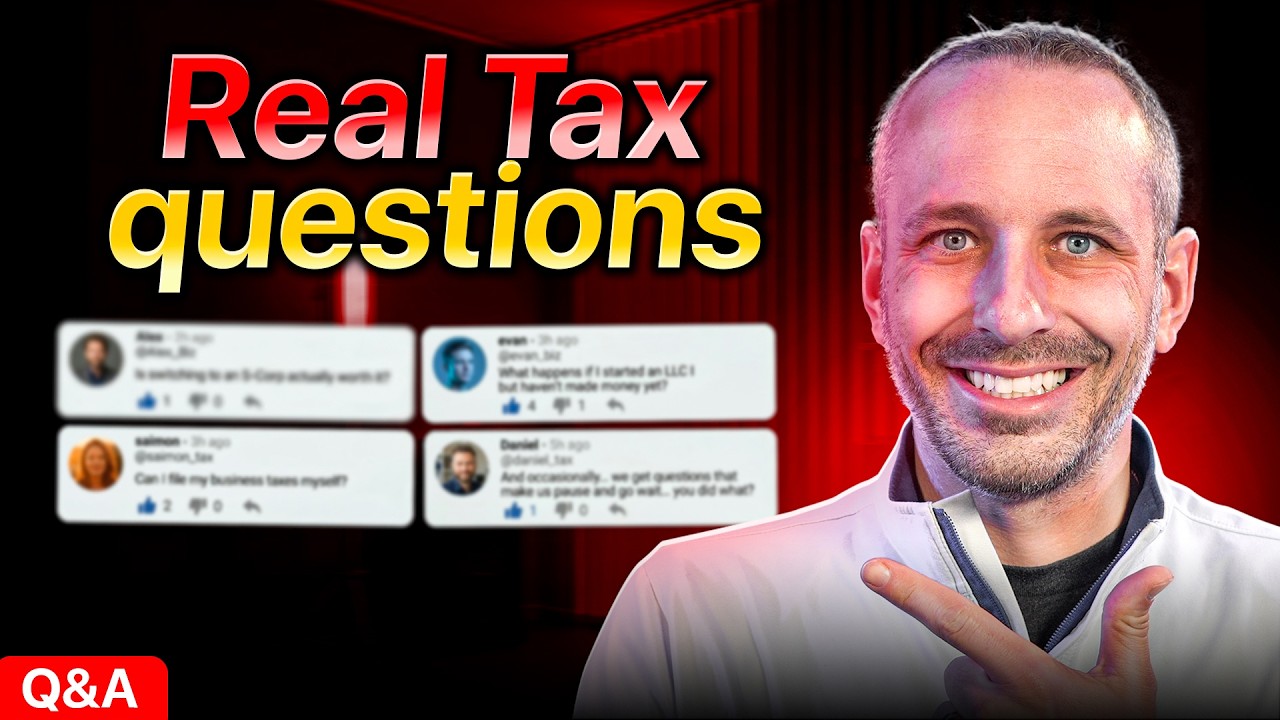
Small Business Tax Questions Answered: S Corps, Write-Offs, and More
The most common small business tax questions are usually the ones that can cost business owners the most money.
Is an S Corp actually worth it. Can you file business taxes yourself. Can a business loss offset other income. In this episode, we answer real small business tax questions from real business owners and explain what matters, what to watch for, and where mistakes often happen.
Can You Deduct a Business Expense and Still Report Income If You Sell It?
Yes, and both things are true at the same time. If you bought something for a legitimate business purpose, it is deductible. But if you later sell that item, the income from the sale still needs to be reported. You cannot offset one against the other and call it even.
The key test is whether the expense was ordinary and necessary for your business. If it passes that test, great. Just make sure you are also reporting what you receive when you sell. Both sides of the transaction matter.
Do You Need a CPA for a Zero-Activity Partnership Return?
Even a zero return can be more complex than it looks. If you have a partnership with no activity, you still need to file Form 1065. And setting that up correctly the first time really matters because it becomes the foundation for everything going forward.
Most CPAs will charge a reduced rate for a zero return since there is not much to report. But it is still worth getting it right, especially when it comes to partner information and initial filing structure. That first return sets the tone for every future one.
Can a Business Loss Offset W-2 Income?
In many cases, yes. If you are running a real business and you materially participated in it, losses from that business can offset your W-2 income. The simplest way to meet material participation is to work at least 100 hours in the business and more hours than anyone else.
The thing the IRS watches for is whether your activity looks more like a hobby than a business. If you are consistently losing money year after year without a path to profit, that is when it starts to become a problem. First-year losses are generally fine. Just make sure the business is moving toward generating real income.
Is an S Corp Worth It at $120,000 of Profit?
Typically, yes. Here is the basic math: as a sole proprietor, you pay self-employment tax on your full profit. With an S corp, you pay yourself a reasonable salary and only that salary is subject to payroll taxes. Everything above that salary passes through as a distribution, which is not subject to self-employment tax.
At $120,000 in profit, a reasonable salary might be around $50,000 to $60,000. You are saving roughly 15% in self-employment taxes on the difference. Subtract the cost of payroll and a more complex tax return and it is usually still a solid win. The key is making sure your reasonable salary is well documented and supportable.
Do Higher Income Levels Limit Your Tax Strategies?
Not necessarily. In a lot of cases, higher income opens up more options, not fewer. Yes, some strategies phase out at higher income levels. But there are also more advanced strategies available to high earners, and the stakes are higher, which makes proactive planning more valuable.
The bigger point is that higher income means the cost of not planning is higher too. This is exactly when working with a tax strategist, not just a preparer, starts to pay off in a real way.
Can You File Business Taxes Yourself?
It depends on your business structure. A Schedule C return for a sole proprietor is the most straightforward. A lot of self-employed people handle that themselves using tax software, and that is fine if they are doing it correctly.
Partnership returns and S corp returns are a different story. These are more complex than most business owners expect. We see a lot of self-prepared returns that are off in ways that create real problems later. If you go that route, at minimum get a second set of eyes on it before you file.
Can You Deduct Business Expenses Paid on a Personal Credit Card?
Yes. The payment method does not determine whether something is deductible. The business purpose does. New business owners pay startup expenses personally all the time before they have a dedicated business account set up, and those expenses do not lose their deductibility because of that.
The key is documentation. Keep a spreadsheet with the date, amount, and business purpose for every expense. And going forward, open a separate business account and keep things clean. It makes everything easier at tax time and reduces the chance of anything getting missed.
How Does the Family Management Company Strategy Work?
The idea is to run a separate sole proprietorship that pays your kids for real work they do in the business. When you hire your children through a sole proprietorship instead of an S corp, you do not have to withhold for FICA taxes. That is a legitimate, black and white rule in the tax code.
Your S corp pays the sole proprietorship as a contractor for services like social media or admin work. The sole proprietorship then pays the kids. If their earnings are under the standard deduction, they owe no income tax either. It is a real strategy with real savings, but it has to be set up correctly. Agreements between the entities, documented work, reasonable pay for actual tasks.
How Do Business Vehicle Write-Offs Actually Work?
Vehicle deductions are completely legitimate, but only when they are implemented the right way. There are two methods: the standard mileage rate and the actual expense method. The right choice depends on how much you drive for business and what kind of vehicle you have.
What trips people up is taking a higher deduction than the actual business use supports. Every business owner should have some automobile deduction, even if you work from home, because there is always some business driving happening. Just make sure you are tracking it throughout the year. A mileage log with the date, destination, and business purpose for each trip is what you need if the IRS ever asks.
How Does the Augusta Rule Work for Business Owners?
If you rent your personal residence for 14 days or fewer per year, that rental income is not taxable to you. For business owners, the strategy looks like this: your business rents your home for a board meeting or strategy session instead of a coworking space, and pays you the going rate for a comparable venue.
To do this correctly you need a rental agreement, documentation of comparable rental rates from local venues, meeting minutes with who attended and what was discussed, and a payment made from the business account to your personal account with a 1099 issued at year end. Do it right and it is a solid, fully legal deduction. Skip the documentation and it is a red flag.
Final Takeaway on Small Business Tax Questions
Most tax mistakes do not come from bad intentions. They come from not knowing the rules or applying a strategy without the right support behind it.
Good tax planning is not just about knowing what is possible. It is about knowing how to do it correctly, with the documentation and structure to back it up. Hopefully hearing these questions helps you realize you are not the only one trying to figure this stuff out.
Want Help Putting This Into Practice?
If you are asking these kinds of small business tax questions in your own business, the best next step is to get a system in place before mistakes get expensive. Listen to the full episode, grab the Tax Savings Starter Kit, or book a call with the TaxElm team at taxelm.com.
Frequently Asked Questions
Can I deduct business expenses paid with a personal card?
Yes, if they were legitimate business expenses and you kept good records. The payment method does not affect deductibility.
Can a business loss reduce my W-2 taxes?
Yes, in many cases, especially if the activity qualifies as a real business and you materially participated. Hobby losses are not deductible against ordinary income.
Is an S corp worth it for a small business owner?
Often yes, but it depends on your profit level, what counts as a reasonable salary, and the added compliance costs. It is generally worth exploring above $80,000 to $100,000 in net profit.
Can I file a business tax return myself?
For a Schedule C, possibly. For a partnership or S corp return, these are more complex than most people expect. Professional preparation is strongly recommended.
How does the Augusta Rule work?
It allows you to rent your home to your business for up to 14 days per year. When done correctly with the right documentation, comparable rates, and a clear business purpose, the rental income is tax-free to you and deductible by the business.
Transcript
Okay. Every once in a while we open the floor to real questions from real business owners. And honestly, these are some of my favorite episodes because the questions people ask reveal the exact tax confusion happening out there right now. You know, we hear things like, is switching to an S corp actually worth it?
Can I file my business taxes myself? And what happens if I start an LLC but haven’t made any money yet? And occasionally we get questions that make us pause and go. You did what? So today we’re doing a listener q and a and walking through several questions pulled directly from business owner communities.
Some are common situations, some are a little unusual, but all of them highlight the tax decisions that business owners face every single. Okay.
Gold Business Cards Sale
So let’s dive into this and the first question that we have is from our as a [00:01:00] nominees Facebook group member from our Facebook group. If you’re not yet a member of our Facebook group, go there now.
Go to Facebook, type in small business tax secrets, answer a few questions and join the free Facebook group. But this was from an anonymous member there and they said, hello. I am curious to hear everyone’s thoughts. I was paying a company, a large marketing fee to create pure gold business cards with my brand stamped on them.
I was in a pinch and sold them for cash for more than I originally purchased them for, which was great. It doesn’t seem like a legitimate tax strategy. My question is there is a way to legitimize this transaction, or is it better just to avoid it altogether? Well, first off, I don’t know what business you’re in, but that’s very interesting to have, um, pure gold, business cards.
And so, you know, I, I think it’s possible. Again, I don’t, I would assume you’re in a very high end type industry, so just make sure that is an ordinary, necessary business expense. That’d be the first thing I just wanna make sure of there, but either way. If you bought, an item for advertising purposes, and if this was legitimate, it was ordinary necessary in your business, your industry, everything else, let’s say that we checked that box and we take an expense for that advertising expense, perfectly [00:02:00] fine.
But now you’re taking that expense that you have and you’re selling it, that you’re no longer just using as advertising, but you’re now selling it and receiving income from that. In that situation, you’re gonna have some income. So if you bought it for a hundred dollars. And you took an expense for that, and now you’re selling it for $120, you’re gonna show $120,000 or $120 in income.
So is this legitimate? Yeah, it’s perfectly legitimate as long as you’re reporting that, that income, of course. So just know that there is going to be, income reported on that now. Let’s say you bought those and you treat it as like an asset. So gold is an asset. Let’s say in your business you had some extra cash lying around and you wanted to put gold away in the business, and let’s say you bought a thousand dollars of gold.
Let’s not take business cards outta this of a thousand dollars in gold that doesn’t have a business purpose. In that instance, it’d go on your balance sheet. As an asset, and so on that balance sheet as an asset, it’d be a thousand dollars in gold, no expense, no income yet, and then you sell it for $1,200.
Well, [00:03:00] now you’re gonna take that off your balance sheet, so a thousand dollars goes away and you’re gonna have a $200. Gain. So in that instance, there was no expense. You’re just showing a gain based on what you bought it for versus what you sold it for. But in your situation when you’re talking about business cards, you’re taking that expense up front.
Now when you sell it, you gotta show a full gain for that whole, for that full amount. So just make sure you reporting that correctly and you’re fine there. But again, make sure, check that ordinary to say thing. Gold business cards, I’m sure in some industries can be super powerful, but, you don’t, we don’t see that too often.
Zero Activity LLC Return
Next question is from Amy. Amy says, registered for a new LLC in October, but haven’t done any business yet. The IRS wants a 10 65, zero point in hiring a CPA yet when there’s nothing to. Do,
how do I file online? What is the best site? Thanks. So I’m assuming if it’s a 10 65, that means that you have a partnership and so you started a partnership.
You have multiple partners and, there’s just no activity. So zero activity. So it’s basically gonna be a zero return. First thing I would say is, check with a CPA. When we get to business returns, they can be a little bit more complex in self prepping them [00:04:00] can be. A little dangerous, especially for a 10 65 or 1120 s, which would be an S corporation.
Not to say it can’t be done, but you just need to make sure you’re doing it correctly. Now if you’re just filing a zero return, most CPAs, most firms you go to will have a much discounted rate for that because it’s just a zero return. Now, there’s still work to do because you have to file all the partner information, get all that information gathered, and it’s gonna be a solid, a starting point when you do start to have activity in that.
But it’s usually gonna be a reduced fee, so just check that route. Otherwise, there’s definitely software out there. Again, I just wanna make sure you’re doing it correctly, but there’s software out there. You could look at, TurboTax or Tax Act as some of the other ones, plenty of self prep software out there.
But just make sure you’re doing it correctly because those business returns can get complex, even if it’s a zero return, they can still get complex as some of the information that you need, and that’s gonna be your foundation, especially if this is the first year, that’s gonna be your kind of foundation to your initial return.
So just double check that.
Side Hustle Losses vs Hobby
The next question we have is from Rachel, and she said, I started my business as a side hustle while working a full-time W2 job. [00:05:00] The business didn’t make much money the first year and actually had a small loss. Can I use that loss to reduce the taxes for my regular job income or does the IRS consider that a hobby?
So Rachel, one thing you mentioned is that you started your business. So what the IRS would look for is, if it’s a business that is continually losing money, so losing money, losing money, losing money, losing money, then they would start to look at that as a hobby. But they don’t normally determine in the first year whether a business is a hobby.
And the best, best example I can give from this, let’s say that you’re a race car driver at a local track, and so you’re just. Spending money, money, money. This race car, you know, every, most race car drivers don’t make money. Especially these small local tracks. And so you’re spending all this money and you might say, well, this is a business ’cause I’m gonna, you know, be a race car driver.
The IRSs can look through that and that’s a good example of a hobby. When you’re just spending all this money, that’s a hobby. But when you start to produce income, some of these race car drivers produce income and have valid businesses where they’re making hundreds of thousand dollars, on an annual basis from this.
What I would call hobby, but there may, it’s, it is a true business for them and that’s [00:06:00] legitimate. So, the first year does not determine whether it’s a hobby or not, per se. If you were continue to lose, then it’s gonna become a hobby. Those losses would be disallowed. Now, if you want to be able to use those losses to offset.
You have W2 income or other business income of yours, you need to materially participate in that business. So if you materially participate in the side hustle, then you can use those losses to offset other W2 income. But then just make sure in future years that you start to generate a profit in that business.
Now, what does material participation mean? Multiple different tests that you can take. The easiest one, the one that we see the most common is that you spent at least a hundred hours, working in that side hustle and more hours than anybody else in that business. If you hit that, you hit the material participation test, and you can use those losses to offset, but just make sure again, that we don’t make this a consistent loss.
Or if you expect it to continue to always lose money, then it would be treated more like a hobby. So just make it, make sure you’re watching that.
S Corp Worth It
We have a question from Andrea and she said if you have personally switched to S corp for your business making over $120,000, do you feel it was [00:07:00] worth it?
I have already switched and I feel since I am a one woman show, the payroll cost extra accounting and extra cost with my tax accountant. Worth it. Just curious about others’ experiences. Andrea, a hundred percent agree. I would say that it’s definitely worth it. Now we would wanna look at what is your reasonable salary.
So if your profit’s $120,000 and you do all the math and work and everything else, and you find out that your reasonable salary’s $110,000. Probably not gonna be worth it, but that’s not usually the case. Generally stating back of the napkin. Rough idea, again, not defensible, but a rough idea for a reasonable salary is it’s usually somewhere in the 40 to 50% of your profit.
So if you’re making $120,000 a year. You’re taking a reasonable salary of 50, $60,000 and you’re saving self-employment taxes, 15% on 50 or $60,000. That’s a significant number, and so yes, that can be super beneficial, especially the only outdated cost you have is payroll. Now we’re talking maybe 50, 60 bucks a month.
And, the extra accounting work, not [00:08:00] necessarily accounting work, but a more complex tax return, maybe a thousand, $2,000 a year. So we’re saving, you know, 5, 6, 7, 8, $9,000 in self-employment taxes, and we maybe add additional 22,000, 2,500, something like that in, in additional costs. So. Definitely worth it.
A little bit more complexities, but love, the idea of an S corporation can be super powerful, but just make sure you have a good handle on what that reasonable salary is. You have support to back it up. And it still makes sense in that aspect. But S Corp definitely a route that we’re talking every day with business owners about and the power behind it.
High Income Strategy Limits
We had a question from Jenna and she said, my business had a really profitable year, but I also had a lot of personal income from investments. Is there a point where making more money actually starts limiting the strategies I can use? That’s a great question, Jenna. In not necessarily limiting the strategies that you can use.
But oftentimes opens up the door to additional strategies that you might not have had. You know, when we talk about tax strategy, I like to call strategies core tax strategies and advanced tax strategies. Core tax strategies are those that are available to business [00:09:00] owners of all shapes and sizes, regardless of your business.
They’re available to you. It’s a lot of what we talk about. Think of hiring your kids, home, office, s corporation, all those types of ideas. And then we also talk about advanced strategies, and we say once we have done everything we can. With core strategies, we start to look at advanced strategies. And in order to qualify for advanced strategies, you typically need income in the three, $400,000 or more.
And that’s when we can start opening up the door to some more advanced strategies. So the more income you’re making, the more potential that we can take and use advantage of core strategies more, but then also open up the door to for some advanced tax strategies as well. So does it limit the strategies you can use?
No, I would say it opens up the door to utilize those strategies even further, and also opens the door for some strategies. That maybe aren’t available to someone in a lower income, uh, situation. But what that means also is that you start to get phased out of certain things. So QBI might start to phase out.
You might have a, a salt or state and local income tax limitation that starts to phase out as your income increases. But that even gives us more [00:10:00] power to say, why do we even need to do more planning so that we can get our income below that? Using advanced strategies, using core strategies so that we’re back in those phase limits.
So definitely tons of planning available for you, Jenna.
DIY Taxes for Sole Props
So we have a question from Shy Dog and they say, I’m a sole proprietor.
Been running my auto repair shop for 15 years at one time in the prime economy. Before COVID-19, I was doing $200,000 a year in auto repair sales. Now, the last two years, I have dropped down to only 14 to $18,000 in auto repair sales. Years [00:11:00] ago, I was having a tax account do my taxes for me. I just give them a list of all expenses I incurred for the year, and they input the information.
I’m just wondering if I can get. Some software or something to do the taxes myself. So the one thing you mentioned was that you’re a so proprietorship. So what does that mean? It means that your business activity is gonna be filed on your personal tax return. So you don’t have to worry about a separate business tax return, a partnership return, or an S corporation return or anything like that.
Now. You maybe should have been in S corp before looking at some of those later years, but now you wouldn’t want to be uh, and your sole prior. That means that your business activity is gonna be filed directly on your personal tax return. There’s no separate business tax return. It’s gonna be on your personal tax return via a Schedule C.
Can you do it yourself? Yes. There’s software out there. Think of things like, TurboTax, think of things like tax act, plenty of self prep software out there. But again, just be careful, you know, taxes can be confusing, especially for someone that maybe doesn’t have their head wrapped around it or doesn’t fully understand it.
Just be careful because, the iris can start to trigger some obvious mistakes, especially when it comes to Schedule C filings, which is where your return will be [00:12:00] filed, and, you just wanna make sure that’s taken care of. Now also look at pricing. Because you know what, what might be some of these softwares once you start adding in a business return that you’re doing a Schedule C, I mean that you’re doing in your business, you start to add all these schedules, some of those software prices start to creep up and then it might make sense, oh, it’s maybe a couple hundred dollars more to have a professional do it.
Maybe we want to go to on that route, but run the numbers. See if it makes sense. Try it. You know, a lot of the software you don’t pay until you go to file. So try it out and see if you feel comfortable with it. But just try to get a second eye on it somewhere, especially if you don’t, you’re not knowledgeable a hundred percent in this area.
Filing Business Taxes Online
Next question is from Amy and they say, if you don’t use a CPA, which site can you file using strongly to find where you can file business taxes online? So, a lot of questions around this self prepping and I get it, especially in this day and age, you know, pricing for business tax returns, especially 10 60 fives.
1120 Ss. 1120, they can be more complex. And so there is a reason that pricing is higher because they’re more complex. There is software out there that you can do it. Again, TurboTax Tax Act, I’ve talked about some of these. Google it, there’s even [00:13:00] more out there. So there is stuff out there.
I just wanna caution everybody. I’m not trying to push you away from that or push you towards it. I just wanna caution everybody, just make sure you’re doing it right. Have a second eye. Have somebody, you know, if you know this stuff pretty well. Myself, before I ever got into taxes, I would file my own taxes using those software but then I also see a lot of people at self prep and, you know, back in my days of doing tax returns, I’d see a lot of people at tax self prep, and I’m like, I think we should amend that return because it was way off. So just be careful. Make sure you’re doing things right. If you’re not super nodule in this area, find somebody that is to maybe look through it.
Deducting Pre-Bank Expenses
We have a question from Mark and he said, I started my business halfway through the year and used my personal credit cards for most of the expenses before opening a business bank account. Can I still deduct those expenses through the business or did I mess that up? Mark, great question. And you know, something happens all the time.
Of course. I preach and really stress this idea of separating business transactions from personal transactions and always having a separate bank business, bank account. But where I see this most often is new business owners. They maybe don’t have that account set up yet, or something like that, and so they’re [00:14:00] in your situation.
The biggest thing I say is, yes, you can still get a deduction for those they’re valid business deductions. Keep ’em on a spreadsheet, the date, transaction description, the amount, the business purpose for it, keep it on a spreadsheet and just file those expenses as you would any other regular business expense.
Biggest thing is moving forward. Make sure that we’re not doing any business expenses in your personal account. Make sure you create that separation. So yes, it’s okay in the first year before you had that account opened up, you know, yes, it’s okay for that. Take advantage of what’s available to you, the deductions available to you, but moving forward.
Make sure we create some of that separation.
Paying Kids via Schedule C
Our next question is from an anonymous Facebook group member, and they said Paying children with an S corp involved. An S corp owner pays himself, his wife and two kids through the S corporation, but wants to move to the family management company model using a Schedule C to avoid payroll taxes for the kids.
A great strategy we talk about all the time in tax up, they said seems disingenuous and indefensible to move only the kids and maybe the wife to the Schedule C since the [00:15:00] owner would still be required to continue taking payroll from the S corp and he can’t pay himself via Schedule C. I could see having the wife on the management Schedule C and leave her as the only person receiving a W2 from the S corp, but then they are still left with the cost of running payroll from two separate companies.
How are people moving payroll off the S corp to a Schedule C for the whole family? Okay, great question. And I’m a Facebook group member. First things first, the owner of the company, if it’s the husband, the wife, both of them together, whoever the owner is, they must take a salary out of the S corporation.
You’re not avoiding payroll taxes as you can’t even legally take a salary out an S corporation, out of a Schedule C as the business owner. So the owner of the S-corp, nothing’s changing for them. They’re gonna be taking that salary outta the S-corp and we’ll do it anyways. Now, in this instance, you said the owner pays himself, his wife.
My first question is the wife, well, what is the wife doing in the business and what is the point of paying the wife? Typically, we say there’s only two reasons that we would hire a spouse in our business. One, we wanna maximize the amount that we’re put able to put [00:16:00] away into retirement using the business retirement account.
So we’re gonna add our wife to our spouse to pay, and we can bump that up. Or we have high medical costs and there’s some strategies around that. Now, the only other reason you hire ’em is if they’re actually doing work and they’re a real life. Breathing, walking, talking W2 employee. And of course we gotta pay them as a W2 employee that, so at first, that’s what the wife does in the business.
And if we’re using it for those two different strategies or something else. Now the two kids in this family management company idea, something we talk about all the time. Because to back up a little bit, if you hire your kids out of an S corporation and their income is under the standard deduction, they’re not gonna pay income taxes on that income, but you still have social security, Medicare, or FICA taxes or payroll taxes that need to be paid on them, and that’s roughly 15%.
Half is paid by the employee, your kid and half is played by the employer. You now, if you hire that same KI children out of a sole proprietorship. You do not have to withhold for FICA taxes. There’s a law that, that Iris black and white says that if you hire your kids in a sole proprietorship, you do not need to withhold for FICA taxes.
So that’s the power [00:17:00] behind a sole proprietorship is that they would not only if they’re understanding auction, not only not have income taxes, but they also wouldn’t have to pay payroll taxes on it because they’re paying them outta sole proprietorship in your, they’re your direct kids.
And so that’s why we talk about this idea of a family management company and the process would say. Let’s say your kids are doing social media work for your S corporation, you would have, uh, your S corporation pay this sole proprietorship for advertising, social media type work as a contractor. So S corp’s gonna 10 99, the sole proprietorship, and then we hire the kids.
They’re doing the social media work out of that sole proprietorship. Another way to do this is, let’s say that you own a plumbing business, but then you also have some other income. Maybe you do a coursework, maybe you have some speaking engagements. Maybe you have a book that you wrote. So, but let’s say your main business is this electrician or plumbing business.
So that’s gonna be an S Corporation income flow there. But if you had some side gig type stuff, maybe this consulting type income or this book income or whatever it might be, maybe we run that. Through a separate entity, a separate sole proprietorship, and then we [00:18:00] pay our kids using it out of our sole proprietorship using the income from that.
So two ways and multiple different ways that we can get there. But the concept is yes, if we hire your kids outta a sole proprietorship, now we don’t have to worry about payroll taxes completely legitimate. As long as we’re dotting our i’s and crossing our T’s and doing this thing the right way. But again, the owners of the S corporation, we’re not paying them anything outta that sole proprietorship.
They’re not being paid payroll outta that. We still need to pay them a reasonable salary based on the work they’re doing out of that S corporation. That’s a key thing that we can’t forget about. So definitely some powerful planner on there. We walk through this all the time of kind of like, what’s the best way to set this up, tax advantages, things like that.
So just make sure you’re dotting your, i’s crossing your T’s. You have agreements between the companies. The secondary thing is payroll in that sole proprietorship, if it’s just the kids in there. It’s not gonna be very expensive because all you really need to do is file a W2 because there’s gonna be no FICA taxes, there’s gonna be no federal withholding.
So the only thing you need to do at the end of the year is file a W2. So you could just simply transfer money from the sole proprietorship account to the children account based on the [00:19:00] work they’re doing in, in that regular pay. You wouldn’t necessarily have to run that through payroll software as long as you did those forms at the end of the year.
And there’s things like track 10 99 and other software out there that helps make that possible. So that’s, the second part of your question there. All right. Two more questions.
Vehicle Write Offs Done Right
We have a question from Carlos and he said, I’ve heard people talk about riding off vehicles through their business, even expensive trucks or SUVs.
How does that actually work, and how do you know if it’s legitimate versus pushing the line too far? Well, Carlos, and that’s a great question because there’s a lot of people out there. You know, when I always talk about tax strategy, I say correct implementation, doing things the right way is so important.
There’s a lot of people out there that take a legitimate black and white legal tax strategy, but make it illegal. Just because they’re not implementing it correctly. Those people that are taking a hundred percent business vehicle, but don’t use the business at all for business, but because they’re a business owner, they’re gonna take their vehicles a hundred percent business.
That’s not, that’s illegal. That’s taking a valid strategy and making it invalid through implementation. So the biggest thing is here, yes. Can vehicles be, deducted or a [00:20:00] legitimate expense in a business? Yes. Do I believe that every single business owner should have some automobile deduction?
Absolutely. Even if you are a hundred percent work from home, there should be some in there because you’re going to the airport for conferences, you’re going to, office supply, start to grab stuff. You’re, there is some mileage even for someone that’s working at home, there is some mileage in there that can be business related.
So do I think every business owner should have. Some automobile deduction. Yes. Whether that’s actual, or whether that’s a mileage deduction is gonna depend on you how much you have in, and what type of vehicle you have and how much you’re using that vehicle. So the question of is it legitimate?
Absolutely. But you have to do things the right way. You know, make sure you’re dotting your, i’s crossing your T’s on this strategy as well. If you’re only driving a couple hundred miles a year for business. Keep that bit, keep that vehicle in your business name or in your personal name. Don’t take any depreciation on it.
Just do the mileage deduction for those couple hundred miles if you’re driving 80, 90% of that vehicle for business. Of course, let’s take the actual, let’s take advantage of those opportunities.
All right.
Augusta Rule Home Rental
Last question for today. [00:21:00] Question from David, and he said, I’ve heard people talk about the Augusta rule where you can rent your home to your business and not pay tax on the income.
How does that actually work, and what kind of documentation do you need to make sure it holds up if you are ever audited? David, great question. And so yeah, the concept of the Augusta rule is that if you, the law. Is that if you rent your personal residence out for 14 days or less, that’s total throughout the year.
So not like each rental activity, but the total rental days for the entire year is 14 days or less. That income that you receive from that rental is not taxable income to you. So how does this work in a business? Let’s say you’re going to, you’re gonna hold a monthly board meeting. Instead of renting out a coworking space with a boardroom in it, you’re just gonna do it in your house.
Well, that’s a valid business deduction and a valid business reason. So you’re gonna pay yourself rent for boardroom from your business to your personal name, and you’re not gonna pay income taxes on that as long as your total rental days are 14 days or less. A valid, completely valid deduction. Now your question, how does that actually work?
And what kind of documentation is one? We’d recommend [00:22:00] having some type of rental agreement between yourself and your business that indicate what type of the date of the event, what type of event it is, what the rental rate is, and those types of things. You also wanna have documentation of what that rental rate is.
You know, we can’t just make numbers up and say, oh, we’re gonna charge $10,000 for a one day boardroom rental of our house. No. We need to find comparables. What does the local coworking space cost to rent out a boardroom? What does a local hotel cost to rent out a boardroom? Find a comparable and use that as your number that you’re gonna be using for that reimbursement.
If you’re having a client or a team member, stay over at your house. What does it cost for a local hotel room down the road? That’s gonna be your reimbursement amount. So making sure you have some type of agreement. Con rental agreement, making sure that you have a reasonable. Rental rate with backup proof to help document that and support why that rental rate is reasonable, and then making the payment from the business account to your personal account and then doing a 10 99 at year end.
So that’s how a, that’s how you want it. Those are the things you wanna have on file. Again, I recommend making all of this information, having it on file. If you ever get audited, you can just provide that [00:23:00] documentation. The final piece there is if it’s like a boardroom or whatever it is. Document the business purpose and what’s going on there.
So if it’s a boardroom, have a have your meeting minutes in there, who attended, what was discussed, all those different things. Have some documentation to provide that backup that there was an actual business expense for whatever event you held there.
Wrap Up and Next Steps
All right, so that’s gonna wrap up today’s listener q and a episode.
These are the kinds of questions that we see every single week from business owners trying to navigate taxes, business structures, and strategy. So hopefully hearing them helps you realize that you’re definitely not the only one trying to figure this stuff out. If you found this helpful, don’t forget to hit subscribe, hit that like button and share it with a business owner who’s sick of paying too much in tax.
And if you want help from our team of tax professionals implementing a lot of the strategies we’ve talked about today along with so many more, visit us@taxelm.com. That’s T-A-X-E-L m.com, or click the link in the description for a free discovery call with our team. We are helping people like you legally lower your tax bill every single day.
I’ll see you on the next one.
[00:24:00] Thanks for tuning in to the Small Business Tax Savings Podcast. We hope today’s episode sparked some brilliant ideas to help you save on taxes and grow your wealth. If you loved what you heard, hit the subscribe button and share the wealth with fellow entrepreneurs. For a treasure trove of tax saving resources, visit tax Savings podcast.com.
There you’ll find tools, guides, and all the info you need on reducing your taxes. Let’s elevate your business to new heights together. Remember the insight shared here for educational purposes and not specific tax or legal advice. Always consult with a qualified professional for your unique situation.
Until next time, keep thriving and saving.